By Samuel Hermanson
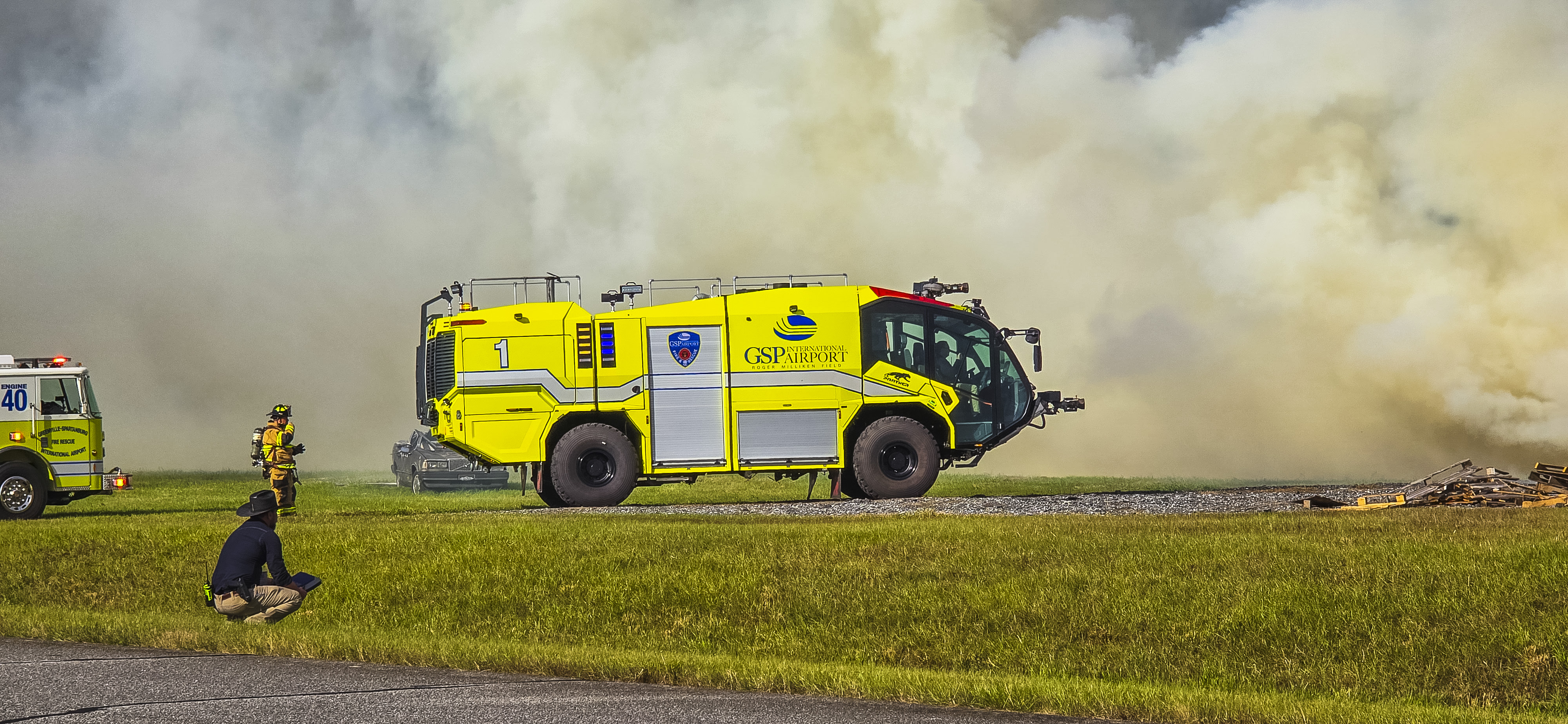
Around 11:00 am on Wednesday, Oct. 2, smoke, emergency vehicles, and a flurry of activity could be seen on the airfield at Greenville-Spartanburg International Airport (GSP). Shortly after, GSP Airport Communications Manager Tiffany Cherry led me, five other USC-Upstate students, and three Upstate faculty members across the airport lobby to a large conference room. We were joined by other GSP communication personnel for a mock press update about the “incident” on the airfield.
All this was part of the airport’s planned full-scale emergency preparedness drill. Something, Cherry explained, that the Federal Aviation Administration requires the airport to do every 3 years. Aside from the mock press update, what grew out of our meeting was an insightful discussion about the protocols and challenges of communicating to staff, media, and the public in the face of an airport emergency. Airport staff also described some of the work experience opportunities the airport offers to college students.
Cherry began the meeting by describing her role and the other positions making up the airport’s communication team. She oversees GSP’s own media outlets (e.g., the airport’s website and social media pages) as well as communication with local or even national media organizations. She is also in charge of customer experience initiatives. Surrounding Cherry is a whole team of people who make GSP’s communications tick both in day-to-day operations and emergency events. This includes a customer experience supervisor, social media specialist, marketing and graphic design specialist, and air service development specialists.
Heading the communications department is Vice President and Chief Marketing and Communications Officer, Tom Tyra. Tyra explained that not all airports the size of GSP have a communication department as robust as his. “It’s kind of a unicorn amongst airports. In a lot of small airports like this, we would have basically Tiffany and Kim (communications manager and social media specialist), and that is it. I’ve worked at a bunch of those places. It’s tough.” Tyra explained that other airports the size of GSP, which he said accommodates 2-3 million passengers annually, would hire a third-party agency to help handle media and communications in an emergency.
One of the ways GSP’s communications department is vital to an emergency response is in informing media outlets and the public about the incident. For informing the media, it’s protocol for Cherry to hold press updates at the airport. That’s where USC-Upstate communication students and faculty enter the picture. We were there as part of the drill exercise to act as the media that would no doubt be swarming the airport in the event of a real accident.
After introducing herself and her team, Cherry made a formal but brief statement about the hypothetical emergency incident:
“At approximately 10:00 am this morning, an Airbus 319 experienced an accident while landing on runway 4 at GSP Airport. The aircraft veered off the runway and came to rest in the grass just north of the taxiway.”
After adding a few more details, Cherry opened the floor for questions. Students and faculty then fired off a slew of queries, including: “Where was the plane coming from?”, “Was the weather a factor?”, “How many passengers and crew were on the flight?” Many of these questions didn’t yield much information, since this statement was given as if only half an hour had passed since the incident.
One set of questions, from Dr. Wren Bareiss, a communications professor at Upstate, stood out as particularly creative, realistic, and persistent:
“There’s some chatter among some social media sources that a group has taken responsibility for this incident. Is there any truth to that?”
“That has not been confirmed at this time. Our media focus right now is on the accident and rescue. And so, at this time, we don’t have any information on that.”
“It hasn’t been confirmed, or you don’t have any information?”
“It has not been confirmed.”
“So, it’s a possibility.”
“I am not aware of any of that information. The accident will be reviewed by the National Transportation and Safety Board, and possibly other federal agencies. But again, the priority right now is rescue. . .”
Dr. Bareiss’s exchange with Cherry was an example of the kind of relentless questioning that is often needed for journalists to pull the truth out of a scenario mired with uncertainty and with fear on the part of an organization’s representatives of saying the wrong thing. Cherry later noted that she could have handled those questions better by restating the facts she could confirm rather than saying the rumor hadn’t been confirmed, implying that it may or may not be true.
Pointing to the fact that sometimes public relations officials don’t have answers for journalists simply because the info isn’t available, Allison Lane, another communications professor from Upstate, asked Cherry to talk about her approach to handling the sometimes-overwhelming number of phone calls, emails, etc., from the media. Cherry replied, “My response would be to be responsive. . . I would keep a consistent message to all media outlets, but I would be as responsive as possible.” She recalled recent incidents when crisis communications, which she defined as messaging related to “anything that could affect our brand and image,” were needed to inform the media. Hurricane Helene and an IT system crash were two such incidents last year.
Tyra echoed Cherry’s emphasis on consistent messaging and explained how GSP’s organizational structure is designed to facilitate that. He pointed out that, as part of its commitment to being customer-focused, the airport provides many information access points to the public. But having so many different people interfacing with the public is hazardous to keeping messaging consistent. “You have to have a very concise–This is the statement. This is what you can say and what you can’t say. –and make sure that as things update and things change, we don’t have people saying the same old message.” He explained that messages concerning an emergency, which are approved by the designated Incident Commander, are dispersed down a sort of organizational “pyramid”. At the top of the pyramid is the Public Information Officer, who communicates with a group of 4-5 people. Each of those people has their own small group to inform. The flow of info continues like this down to the lowest level. Of course, as Dr. Bareiss pointed out, if any one person in this system fails to deliver the correct message, all the info downstream is absent or incorrect. Tyra said the airport reduces the risk of that happening in an emergency by using the same pyramid organization with the same people in the same roles in day-to-day communication.
Media and organizational communication aren’t the only functions GSP’s communication department serves in emergency events. When an accident strikes, in addition to her other responsibilities, Cherry oversees the Friends and Relatives Center. This is a space at the airport for family or friends of people involved in an incident to get information and support. Joining the center this year is the Red Cross. A Red Cross volunteer participating in the drill and our mock press update explained that “We’re trying to reestablish a relationship with the airport to help them and support them in their family reception, family unification center. . . We thought this was a good fit because a lot of the things that we do in our shelter operations, in terms of receiving people into the shelters, dealing with their medical and emotional needs, are things that would be done here in a family unification or reception center.”
Reflecting on the weakness in the department’s performance that the drill revealed, Tyra pointed to some issues involving getting people to the Friends and Relatives Center. Jonathan Sykes is GSP’s Senior Marketing and Graphic Design Specialist, but in an emergency scenario, he said one of his roles is to help “escorting people to the Friends and Relatives Center, which we have in our customs facility.”
He described the trip people have to take to get to the center. “They’re going to come from the information desk to the airline ticket counter. . . They will get a gate pass, they will go through security with the gate pass, and then they will be escorted through a door… to the Friends and Relatives Center.”
Tyra says that route is something that could use work. “I think we found out that taking people down to the custom facility for someone who’s a little, maybe emotional, is a long journey.”
Tyra also said the department needs to figure out a way to increase the visibility of the staff who give info to friends and relatives. He said it’s hard to locate these staff by the colored lanyards they currently wear when the airport is crowded by a flight that’s just landed. He said these and other drill-related shortcomings would be discussed in a later meeting involving all airport departments.
He also noted that GSP does an annual “tabletop” drill, where department heads and other staff talk through what the emergency response should be to a hypothetical accident.
It’s important to realize that the drill on Oct. 2 was a much larger ordeal than our conference room meeting might suggest. According to Tyra, smoke bombs were exploded in school buses to simulate a burning plane, giving firefighters real flames to fight and metal to cut into. There were also people acting as surviving passengers. Some of these were taken to hospitals where medical students practiced evaluating and treating injured patients.
Of course, as an FAA requirement, these drills aren’t optional for the airport, but Tyra sees a lot of value in the exercises. “There’s always something that we can learn and do better. That’s the reason we do this.”
For students looking for out-of-classroom experience, Tyra and Cherry pointed out that GSP offers a job shadowing program and a paid, 10-week summer internship. Tyra said last year’s intern focused on market research and graphic design. In other years, interns have worked in public relations and customer experience. You can find out more about the job shadowing and internship programs here.




Leave a Reply